


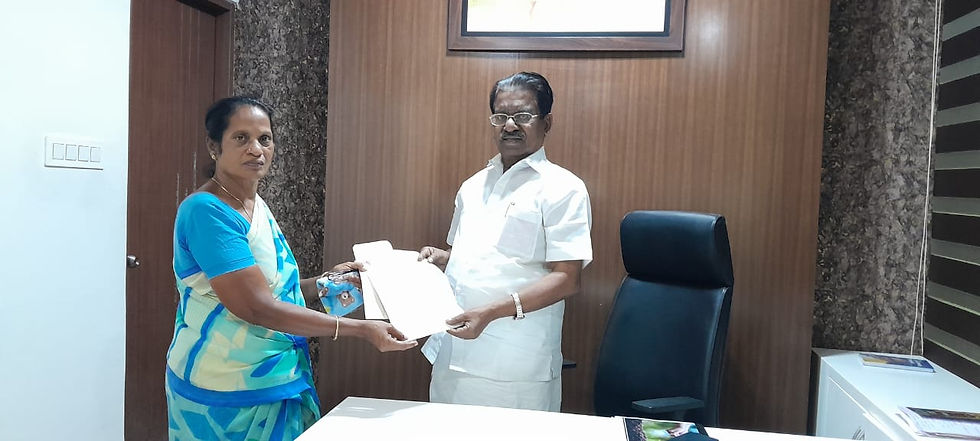
Election Manifesto of the Tamil Nadu Dalit Women's Movement, Tamil Nadu Women's Resurgence Organization, and Rural Women's Liberation Movement
- tnwforum
- Mar 26
- 4 min read

1.Through our movements, we register our deep concern and solicitude regarding sexual violence against women, domestic violence—particularly that stemming from alcohol addiction—caste-based violence, and the atrocities of untouchability. We call upon your party to formulate and implement policies and initiatives aimed at eradicating these evils.
2. A 50 percent reservation of seats in local bodies was introduced to enable women to attain political power. However, women do not function autonomously within these local governance structures. Dalit women leaders, in particular, face oppression due to caste-based discrimination. To rectify this situation, both legislative measures and effective oversight are required. We recommend the formulation of specific programs designed to strengthen the leadership capabilities of women leaders in local bodies through continuous training.
3. In the Ranipet, Kanchipuram, and Tiruvallur districts where we operate, federations of Dalit women farmers must be established; subsequently, government lands suitable for setting up collective farms for these groups must be identified. The District Administration should then lease these lands to the Dalit women farmers' federations. Furthermore, the government must provide these women farmers with training in organic farming, as well as supply them with seeds, tools, and water resources.
4. In the three districts where we operate, Dalit women engaged in self-employment face significant difficulties in securing government bank loans. The TAHDCO scheme has failed to benefit Dalit women. Consequently, women who borrow from external microfinance institutions or private lenders, unable to repay their debts, resort to suicide. Therefore, we request the implementation of a dedicated scheme to empower Dalit women to emerge as entrepreneurs.
5. Constitutionally, ours is a secular nation. However, due to the politicization of religion, its corrosive influence has permeated the very bedrock of society. All oppressed communities are adversely affected by this; we therefore urge your party to formulate an action plan that upholds and champions the principles of secularism.
6. As a result of conducting studies on honor killings, we have been consistently emphasizing the need for a special law to combat this crime. We request that your party take the initiative to spearhead the process of enacting a special law against honor killings.
7. Today, cannabis abuse has become increasingly prevalent, extending even into rural villages. It currently serves as a root cause for various acts of violence perpetrated against individuals ranging from women to children. Consequently, young people are losing their capacity to work and are destroying their lives. We urge you to propose action plans aimed at dismantling all networks involved in the sale of cannabis and establishing drug rehabilitation centers within Primary Health Centers.
8. Liquor shops are currently being established in public spaces—such as bus stands, schools, and markets—where the general public, women, and children frequently gather. This has led to the emergence of various social issues and acts of violence. We request that measures be taken to rectify this situation.
9. Student enrolment in rural schools is on the decline. At the Panchayat level, priority must be accorded to the parents of these children by enrolling them as beneficiaries in relevant government welfare schemes. Furthermore, steps must be taken to ensure and guarantee the enrolment of all children who have completed five years of age into the primary schools located within their respective villages.
10. Currently, facilities for sports training and practice are available to students exclusively within their schools. Specifically, for students residing in rural areas, it is imperative that measures be implemented at the Panchayat level to provide access to sports grounds, equipment, and necessary facilities.
11. Women aged 18 to 30 are predominantly employed in private sector companies, where they work on an indefinite basis. Contract workers receive only half of the wages paid by the company to its regular employees. This disparity must be regularized, and measures must be taken to ensure that, in line with current market rates, a minimum wage of ₹30,000 is provided.
12. Priority in employment—specifically an 80% quota—must be accorded to local residents across all industries and sectors.
13. The number of families within the SC/ST and minority communities has increased significantly, resulting in situations where 4 to 5 families are compelled to live together in a single household. Housing site pattas (land titles) must be issued to these families, and houses must be constructed for them. Furthermore, for all families that have been residing in a location for over 10 years but have not yet been granted a patta, land titles and housing facilities must be provided within the same Panchayat, near their current place of residence.
14. Landless agricultural laborers must be allotted five acres of land per family. Additionally, they must be provided with irrigation equipment, organic fertilizers, and seeds to facilitate cultivation on this land. Priority and necessary infrastructure facilities must be provided at Uzhavar Santhais (Farmers' Markets) to enable them to sell the vegetables produced through organic farming.
15. In 1997, during the tenure of Kalaignar M. Karunanidhi as Chief Minister, land along with Patta, Chitta, and Document No. 105 was allotted to 17 beneficiary families belonging to the Dalit and Irular communities in Thazhavedu village, Thiruthani Taluk, Thiruvallur District. However, to this day, the specific location and identity of the allotted land remain unknown. The land has not yet been formally handed over to the rightful beneficiaries. Therefore, the authorities must identify the exact location of the land and formally hand it over to the concerned people.
16. The hospital currently operating in Arakkonam, Arakkonam Taluk, Ranipet District, suffers from a severe shortage of doctors. Consequently, patients are frequently referred to other hospitals—such as those in Thiruvallur, Chennai, Vellore, and Adukkamparai—under the pretext of requiring advanced treatment. This practice subjects patients to unnecessary hardship and distress; furthermore, the long hours of travel take a heavy toll on both the patients and their family members. Therefore, establishing a medical college in Arakkonam would be immensely beneficial to the residents of the surrounding villages.

This election manifesto—presented jointly by the Tamil Nadu Dalit Women's Movement, the Tamil Nadu Women's Uprising Organization, and the Rural Women's Liberation Movement—advances the ideological principles of figures such as Marx, Periyar, and Ambedkar in the context of contemporary politics and feminist liberation. Grounded in this framework, the manifesto centers its focus on ensuring permanent livelihoods and establishing sustainable, enduring living conditions for Dalit women.


Comments